
Our Research

What shapes our science?
Histones organize all eukaryotic genomes and represent some of the most conserved proteins. Their fascinating gene organization and unique regulation drive our research.
-
Specific condensate targeting
The histone genes are occupied by a conserved nuclear body called the Histone Locus Body (HLB). The HLB initiates early during animal development and is maintained throughout a dividing cell’s lifetime. We aim to define the signals and molecular interactions that ensure the HLB specifically targets the histone genes.
-
Regulation of multigene families
The human genome carries 61 replication-dependent histone genes, while the Drosophila melanogaster genome carries ~500. Members of these gene families must be co-regulated to carefully control histone output. We aim to determine how individual histone genes may be regulated separately or together.
-
Flexibility of regulatory mechanisms
Although developmental and cell cycle histone regulatory patterns are similar between animals, the mechanisms through which histone regulation is accomplished vary dramatically, even between closely related species. Yet, histone misregulation leads to various diseases, including cancers. We aim to explain the paradox of how regulatory mechanisms evolve rapidly if even slight perturbations are deadly.
How does nuclear organization shape efficient gene regulation?
The nucleus is a crowded environment; two meters of DNA fit inside the 6 µm-diameter nucleus of each human cell. Yet despite the compact environment, each cell accomplishes stunningly efficient gene regulation. We study nuclear organization on a variety of levels, using the excellent genetic model system Drosophila melanogaster (the fruit fly):
-
Gene Regulatioon
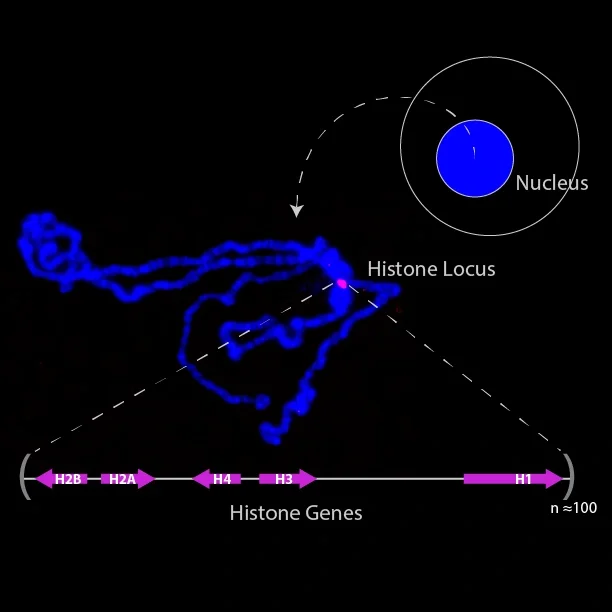
The five histone genes, which must be coordinately regulated, are clustered into a single locus (pink) in D. melanogaster (there are two loci in the human genome). Because the cell requires a huge number of histone proteins at certain times during the cell cycle, there are many copies of the histone genes, arranged in tandem.
We use classical genetics, modern genomics, and biochemical assays to identify cis elements, trans factors, and organizational elements responsible for the coordinated regulation of the histone genes.
-
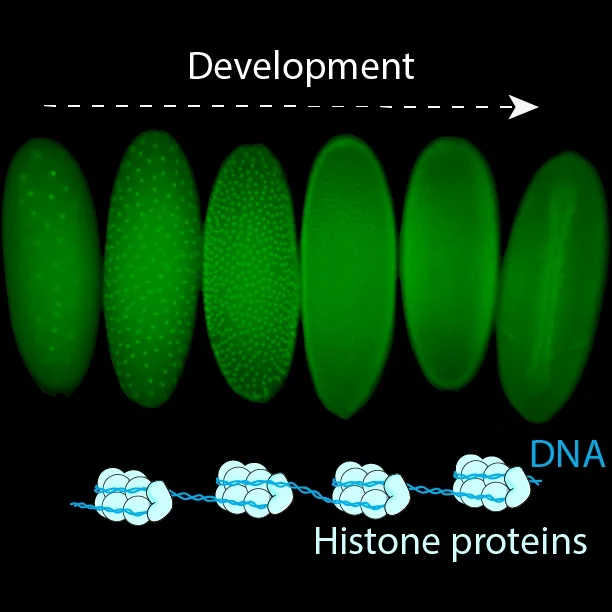
Chromatin
Genes are regulated through a variety of mechanisms, including how the DNA is compacted around histone proteins. Chromatin domains are often established during embryogenesis, setting up critical gene regulation throughout development.
We use genomic techniques to study how chromatin domains are initiated in the embryo and maintained throughout development of D. melanogaster.
-
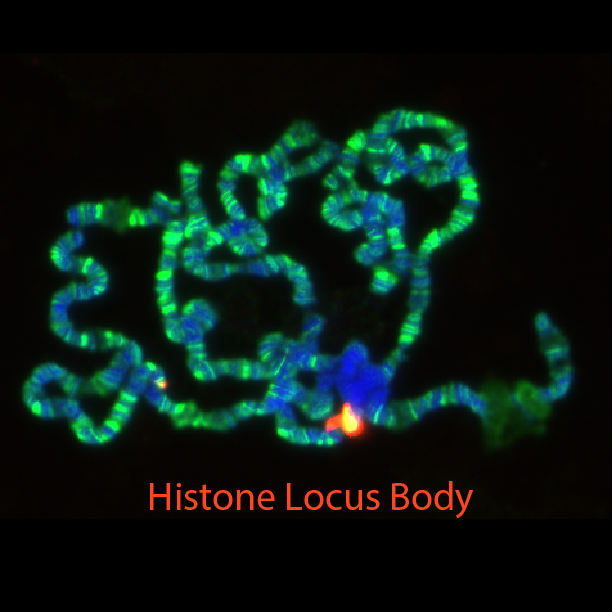
Domain Formation
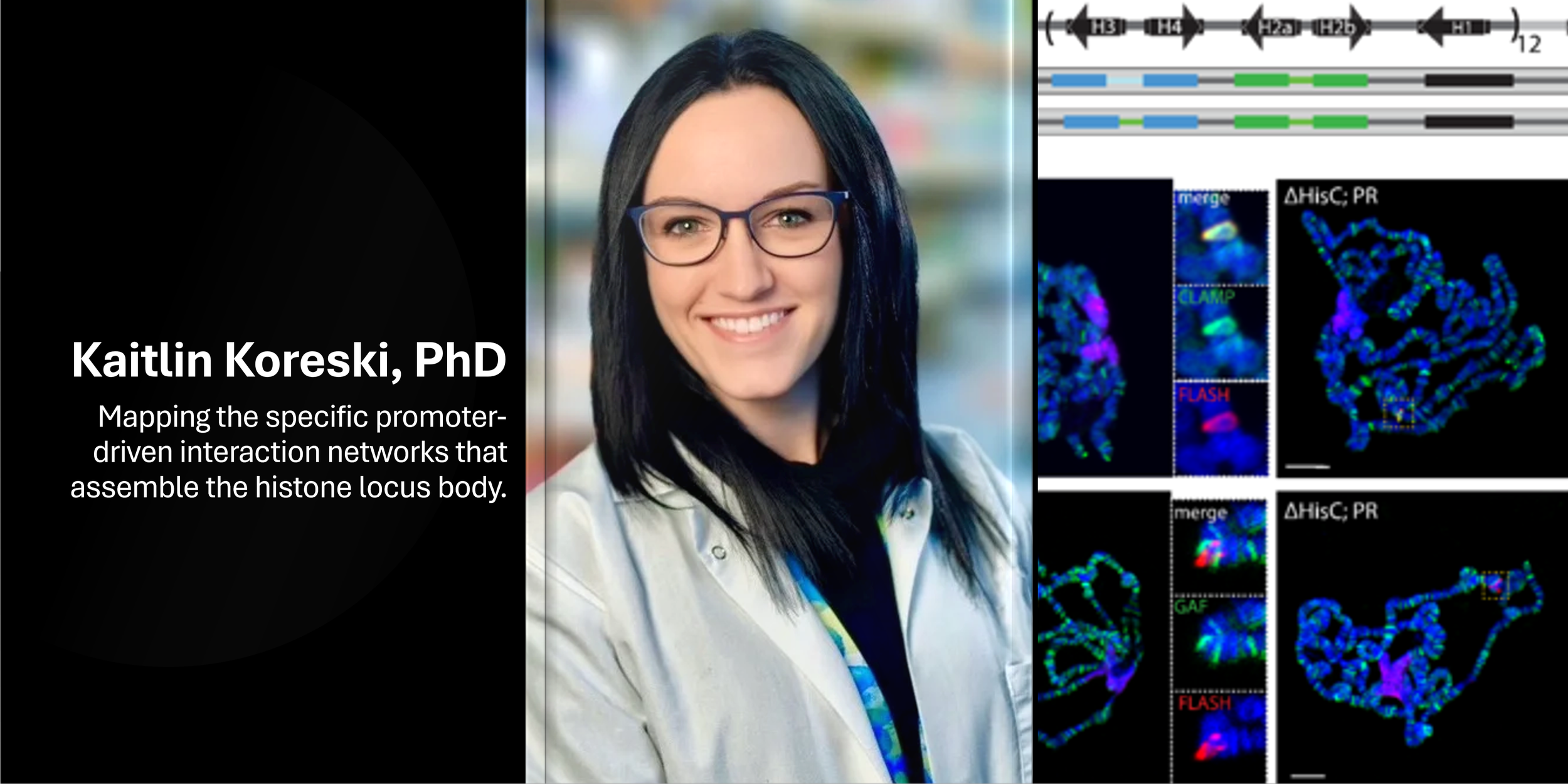
The histone locus attracts a variety of regulatory factors that are critical to proper production and processing of histone transcripts. Collectively, these form a structure around the locus known at the Histone Locus Body (HLB), which establishes a regulatory chromatin domain.
We are studying how the HLB forms at the correct genomic location, how various factors are recruited, and how this leads to proper histone locus regulation.